When agents with Immigration and Customs Enforcement (ICE) finish a long day of raids and arrests in a new city, they usually retreat to a midscale hotel to rest, recuperate, and prepare to do it all again.
But across the country, activists hoping to disrupt the Trump Administration’s immigration crackdown are stepping in to ensure that those agents do not sleep. These noisy protests outside hotels where agents are staying have become a key tactic of anti-ICE activists.
“Immigrant families aren’t sleeping well right now either,” Megan Newcomb, a 33-year-old Minneapolis resident and one of the organizers of a hotel demonstration in her home city last week, tells TIME. “If people staying at these hotels experience the anger and frustration of our community, maybe they can empathize and support impacted communities.”
The ‘No Sleep for Ice’ protests, as organizers have dubbed them, began in Los Angeles during the summer and have since spread nationwide. The protests hit the news again last week, following a nighttime protest in Edina, Minnesota.
At 7 p.m. on Dec 11, about 150 people gathered outside the Homewood Suites by Hilton in the town to protest the hotel for reportedly hosting ICE agents. The protesters chanted, marched in circles around the hotel, and made sustained noise meant to deny ICE agents the ability to rest comfortably, Newcomb says. A smaller number gathered the next evening for a second night.
“The energy was incredible,” Newcomb says. “At times it felt like a dance party.”
The goal of the protests, Newcomb explains, is twofold: to pressure hotels to stop housing ICE agents and disrupt agents’ ability to operate efficiently. She adds that organizers verify through several sources before targeting a hotel where ICE agents are staying.
“Without sharing our methods, I want to be clear that we make sure we are 100% confident in this, using multiple sources of information, before we target a hotel,” she says. She noted that ICE agents have had to adjust their operations due to the protests.
“We have seen agents changing the way they travel and get to and from these hotels in an effort to avoid detection. These changes make things slower and more challenging for them,” Newcomb says. “Any amount we can slow them down through these changes or by having them change hotels is time they aren’t out kidnapping our loved ones. Another win!”
Acknowledging the criticism that the protests also disrupt hotel guests, Newcomb said that the discomfort is part of the message.
Where did it begin?
The No Sleep demonstrations began in early June, when Californian protesters targeted hotels such as Cambria in Burbank, the DoubleTree in Montebello, and others in Pasadena, Whittier, Glendale, Arcadia, Downey, Long Beach, and Hacienda Heights. A sleepless night for both the agents and protesters themselves would typically begin around 9 or 10 p.m. and conclude in the wee hours of the morning.
Sophia Aguilar, a 24-year-old Latina from Northeast Los Angeles, has been protesting since ICE agents arrived in the city in June. “I couldn’t sit by and not do anything,” she tells TIME. “When they arrived to Los Angeles in June, my boyfriend and I protested for one month straight. We went to multiple different protests all around Los Angeles County.”
Aguilar described her experience leading chants during a ‘No Sleep for ICE’ protest at the Westin Pasadena on June 16, 2025. “About 50 people were there, and even though I didn’t initiate the protest, I led the crowd marching around the hotel, as I was the one with the loudest megaphone,” she says. “Being directly outside, where ICE agents could hear us, made the experience feel especially meaningful. Yelling and banging on pots and pans together allowed us to release the frustration we feel over the injustices our people continue to face.”
The protests, Aguilar says, are about solidarity and visibility for immigrant communities. “These protests mean a lot to me as it is a way for our people to know they’re not alone and that we are out on the streets fighting for them in any way we can,” she says. “Immigrants are not criminals — they are hardworking mothers, fathers, sons, and daughters pursuing their hopes and dreams, just like everyone else.”
On June 16, U.S. Marines compiled a list of “LA Hotels to Avoid” after reports of protests targeting ICE and CBP personnel, according to documents obtained by the government transparency nonprofit Property of the People and reported by The Guardian. The list, reportedly prepared by Army North and reviewed by the Navy’s southwest division, drew on intelligence from multiple law enforcement agencies tracking the community backlash, according to the report.
A Marine Corps analyst in San Diego wrote that the list was based on reports of “harassment of ICE and CBP personnel” and sought similar guidance for San Diego hotels, noting, “We have operations in the area and are looking to avoid issues wherever possible.”
Protests spread across the country
The tactic of keeping ICE agents sleepless is being used across the country to disrupt the activities of ICE officers.
In early September, protesters across Chicago’s suburbs began targeting hotels where they believed federal immigration agents were staying. In Downers Grove, a few hundred demonstrators rallied outside a hotel after spotting Department of Homeland Security vehicles in the parking lot and suspecting ICE agents were lodging there. Smaller protests followed outside a nearby Hampton Inn and at an ICE processing center in Broadview.
By late September, protesters in Chicago, Illinois, responded to the stepped-up immigration crackdown dubbed ‘Operation Midway Blitz’ by holding their own hotel demonstrations.
At about 8:30 p.m. on September 23, over 100 protesters gathered outside the Hyatt Place in Medford, Massachusetts, to intensify demonstrations against ICE agents that they had initiated over the weekend.
The protest, which continued until roughly 10 p.m., was fueled by reports that immigration agents were staying at the hotel and by growing concern over increased detentions of Latin American immigrants in nearby Somerville, including the 45-day detention of Tufts graduate student Rümeysa Öztürk. Participants — including union members, immigrant-rights organizers, local residents, families, and children — said the action was inspired by similar hotel protests in Chicago and Detroit, and aimed to show solidarity with immigrant communities while pressuring businesses not to cooperate with federal immigration enforcement.
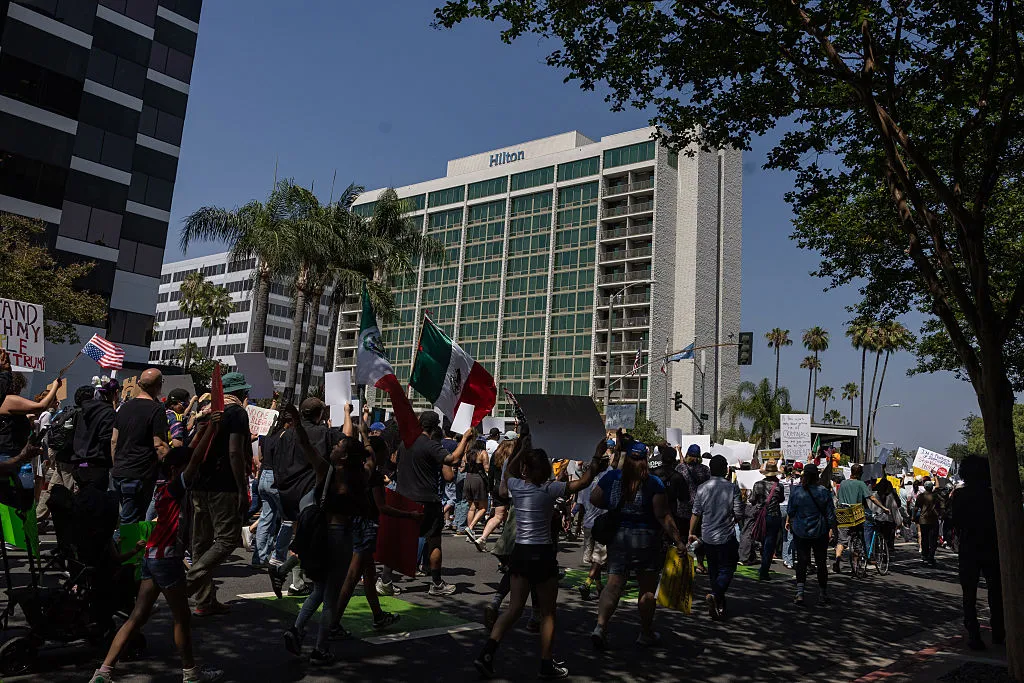
The Hilton Charlotte University Place in Charlotte, North Carolina, on Nov. 19, was swarmed by protesters after residents said they saw U.S. Border Patrol agents coming and going from the hotel during a federal immigration sweep that has led to more than 250 arrests.
Demonstrators said they were there to show solidarity with immigrant families and to pressure hotels not to house federal agents involved in “Operation Charlotte’s Web,” which community members say has spread fear across neighborhoods, schools and businesses. Protesters carried signs, chanted outside the hotel and shared stories of family members, students and customers affected by the enforcement activity. Hilton said the property is independently owned and operated and declined further comment.
Demonstrations have continued steadily into the winter months.
More than 100 residents in Waldport, Oregon, packed a City Council meeting on Dec. 10 after city officials confirmed that U.S. Immigration and Customs Enforcement had contacted the Alsi Resort to inquire about renting hotel rooms, prompting fears the agency was seeking lodging tied to a potential detention facility elsewhere in Lincoln County.
Is it Legal?
Arrests at “No Sleep for ICE” protests have been rare, and legal consequences have generally been limited. In the few documented cases, charges were often dropped or not pursued.
In Long Beach, California, two women were arrested during a protest outside a Holiday Inn where ICE agents were believed to be staying. They were charged with violating local noise rules, but the city prosecutor later declined to pursue charges due to insufficient evidence about who was making the noise.
This decision followed more than five months after Long Beach police arrested Carmen Valdes and Maha Afra during an anti-ICE demonstration on June 25.
What has the Trump Administration said?
Although President Donald Trump has not commented directly on the hotel protests themselves, he has defended the broader immigration crackdowns that sparked them, including “Operation Midway Blitz” in Chicago and similar operations elsewhere. Trump has described such sweeps as necessary to restore law and order and has criticized sanctuary policies and local resistance to federal enforcement.
The Department of Homeland Security did not provide a comment in response to TIME’s request.
In some instances, federal officials have suggested that protests outside hotels could interfere with law enforcement operations. After demonstrations spread across Los Angeles County, military and law enforcement agencies circulated internal guidance advising personnel to avoid certain hotels, citing reports of “harassment” of ICE and Border Patrol agents, an indication that the protests seemed to be having a tangible impact.
Administration officials have not indicated plans to stop using hotels altogether, but have warned that protests targeting federal agents could face law enforcement response if they cross legal boundaries.
The post ‘No Sleep for ICE’: Inside the Protest Movement Keeping Immigration Agents Awake at Night appeared first on TIME.