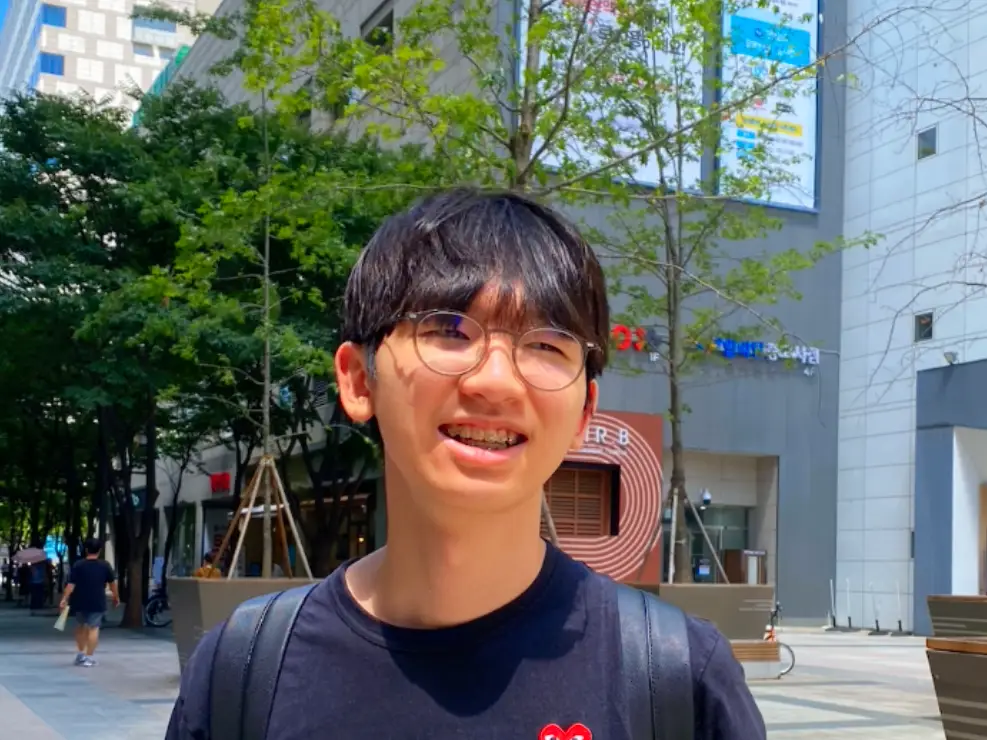
My typical morning starts around 3 a.m. I’m instantly met with Messenger notifications from web developers in California, GitHub pings from Florida, and a running document of research papers to read sent from Michigan. By 7:50 a.m. I’m off to class to live my life as an 18-year-old high school senior in Seoul.
This solitary ritual has become my strange normal after I founded an AI research and development startup with people all around the world, whom I’ve never met in person. My ambition was to improve Alzheimer’s diagnostics, but I had no network, so I built one online.
I’ve always viewed Alzheimer’s as a terrifying disease
Growing up, I heard stories about various family members battling Alzheimer’s. I viewed the disease as something truly terrifying, which leaves behind only the shell of who someone once was.
I’d grown up knowing that someday, someone I love might disappear while still standing in front of me. In high school, this fear crystallized into something beyond passive acceptance.
I came across this competition, looking to fund ideas that can make health more accessible, and decided to apply.
BI’s Young Geniuses series spotlights the next generation of founders, innovators, and thinkers who are trying to reshape industries and solve global challenges. See more stories from the series here, or reach out to editor Jess Orwig to share your story.
I knew I couldn’t do the work alone. I had to find people beyond my network with diverse perspectives and skills capable of building something real together.
I started searching for partners by spending my time on internet forums and pitching my vision. I posted detailed research proposals on Discord servers and created GitHub repositories with preliminary code.
After a month of “nos,” I got one “yes” from California. Then Florida. Then Michigan. Until there were six of us. We named ourselves Reteena (pronounced like “retina”), a deliberate wordplay symbolizing our mission to bring new vision to Alzheimer’s diagnostics.
We became something none of us expected: a team of high schoolers from around the world who genuinely believed we could fix Alzheimer’s.
My team and I decided to make Alzheimer’s diagnostics more accessible and affordable
I didn’t set out to target only high schoolers, but I was on servers mainly for students, and those were the people who responded.
We’ve been self-funded and started by conducting research on enhancing the image resolution of low-field MRI, which is a portable and more economically accessible MRI machine. We applied machine learning and deep learning techniques to enhance the quality of low-field MRI scans.
Our goal was radical — to make Alzheimer’s diagnostics accessible and affordable for underserved communities by making low-field MRI more reliable. Conducting research together, I realized that my abstract dream had become reality, but reality proved far more demanding than any dream.
I started doubting my leadership skills
I staggered under the crushing weight of the time and dedication that my team was giving. The time zone difference was not an excuse for me to make them wait for responses. Lying awake at night, my stomach knotted with anxiety about “what should I do next,” I recognized that my wrong decision could waste months of work from people who believed in me.
During those suffocating moments, when doubt was a physical pain in my chest, I’d question everything: my abilities, our direction, and whether I was worthy of the faith my team placed in me.
Gradually, my leadership improved, and doubts faded when I stopped seeing our differences as obstacles and started viewing them as strengths. I created a “follow-the-sun” workflow where I completed tasks before people in the states woke up, with detailed handoff documents in shared Notion workspaces. We were asynchronous, yet somehow more connected.
When we got published, it was the reassurance I needed to keep going
When our first piece of research was published in the IEEE BigData 2024 Conference, a prestigious annual conference for artificial intelligence research, I felt exhilarated. It was proof that we were onto something and justification for every late night. Yet it was only the beginning.
We expanded from a six-person group chat into an unconventional startup with 12 members. Over the next nine months, we conducted additional Alzheimer’s research and presented our findings on how changes in speech patterns and genetic markers could aid in detecting the disease earlier than traditional methods.
As people who met on the internet, we’ve also made our growth transparent on the internet, sharing our journey on LinkedIn. By posting our product-building journey and sharing the authentic rationale behind our research and products, we connected with mentors who believed in what we were doing — Y Combinator founders, Pear VC partners, and researchers who took us seriously despite our age.
We even started receiving messages from students across different countries asking for advice on starting their own health tech projects.
We’ve launched our first product
Most recently, we launched our first consumer product, Remembrance, an AI therapeutic service to try to help Alzheimer’s patients reconnect with their past. It works by asking gentle questions designed to trigger old memories through reminiscence therapy.
Each recalled memory is automatically organized in knowledge graph databases, making it easy to revisit and build a personal memory repository. Over time, it can suggest related memories on demand, building a personalized memory archive.
The healthcare market is impenetrable in many ways. When we attempted to approach a local hospital to test our product using actual patient data, we were immediately halted by compliance requirements and institutional review boards.
I’m grateful I’ve learned all of this in high school when the stakes are lower
We’ve spent two years discovering that building something in healthcare is harder than we thought. But I wouldn’t change it because we learned that at 17 and 18, not at 25 when the stakes feel higher and the fear feels heavier.
Reteena might not end up as we imagined, but that’s OK. The point was never the destination; it was about learning how to build, understanding that authentic problems matter more than viral success, and realizing you can inspire people by simply trying.
That’s the real experiment. And it’s worth every sleepless night.
Read the original article on Business Insider
The post I’m 18 and cofounded an AI startup with teens around the world who I’ve never met in-person. I had no network, so I built one online — here’s how. appeared first on Business Insider.