A member of Congress has proposed a theory that Donald Trump is taking a $26,500 anti-Alzheimer’s medication, intensifying pressure for answers on his health.
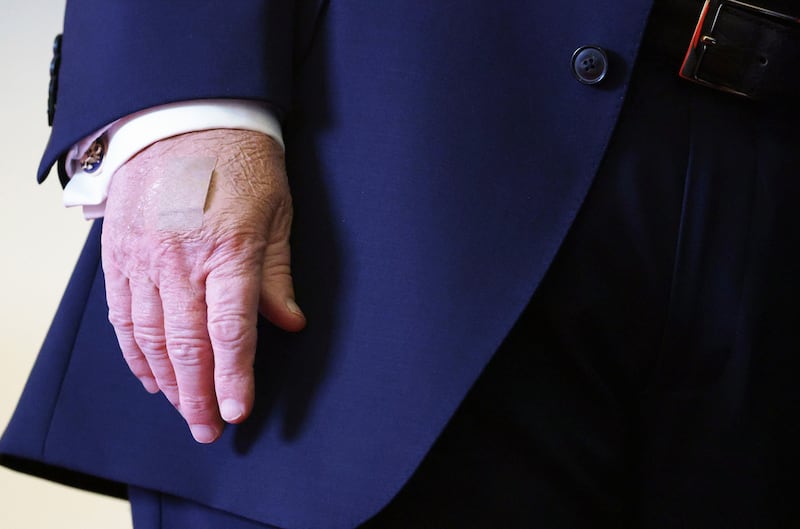
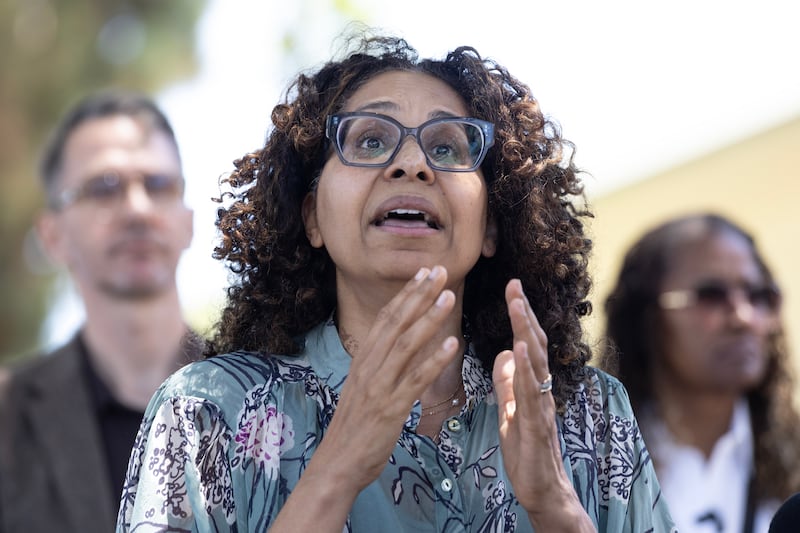
Sydney Kamlager-Dove, a Democrat who represents South Los Angeles, re-posted her theory an hour after the Daily Beast’s Farrah Tomazin cornered White House Press Secretary Karoline Leavitt about the bandaging on Trump’s hand.
Leavitt claimed the president “is constantly shaking hands” because “The Oval Office is like Grand Central Terminal,” and linked it to his daily aspirin regime.
“He is meeting with more people than any of you even know about on a daily basis,” she added.
Tomazin also pressed Leavitt on Trump’s disclosure this week that he had three cognitive tests. Asked by the Daily Beast to clarify their dates, Leavitt said she would provide that information “at a later date” and that “the president has spoken about that quite extensively over the years.”
However, Trump did not mention how many cognitive tests he had taken until his Truth Social post this week, and did not outline when they were conducted.
After Leavitt spoke, Kamlager-Dove almost immediately renewed her suggestion that Trump, 79, is taking the anti-Alzheimer’s drug Leqembi.
“Hey, I’m just asking questions,” she wrote as she reposted a screenshot of the theory she first posited on Dec. 4. She also attached Trump’s rambling Truth Social boast about how he aced three dementia tests and suggested it was “treasonous” to talk about his health.
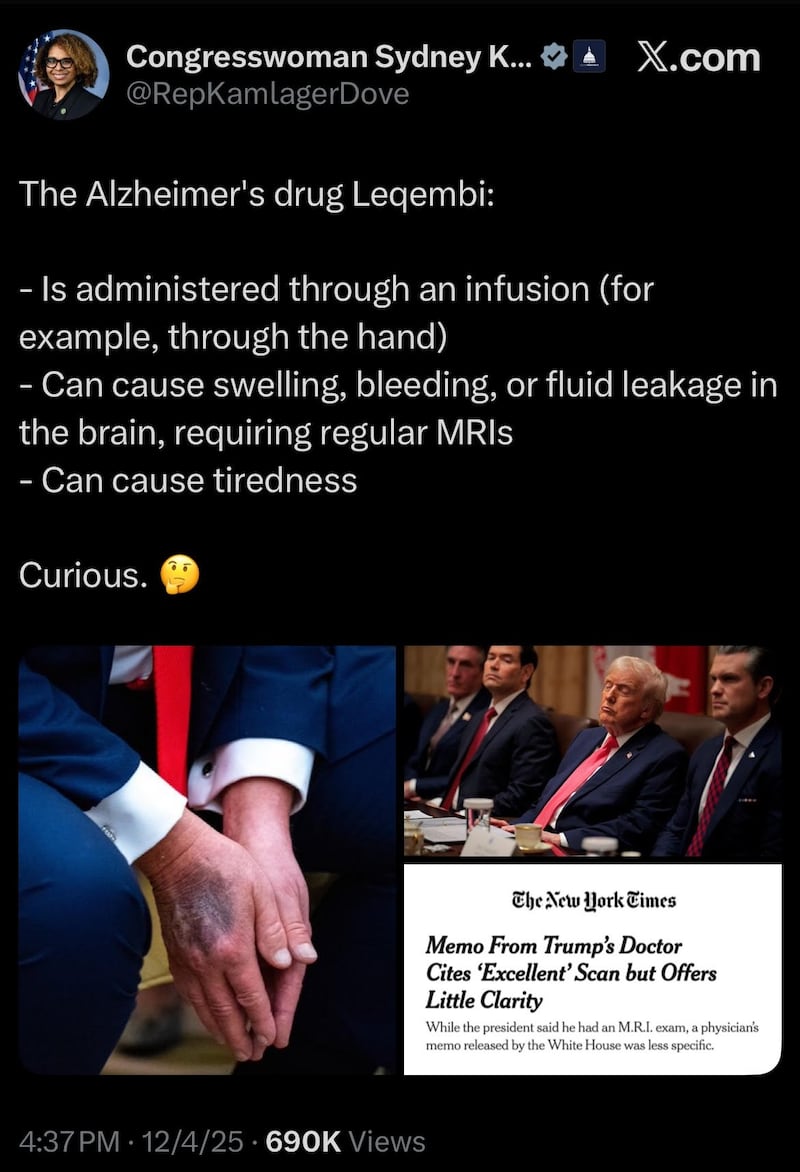
In her Dec. 4 post, Kamlager-Dove wrote, “The Alzheimer’s drug Leqembi: Is administered through an infusion (for example, through the hand); Can cause swelling, bleeding, or fluid leakage in the brain, requiring regular MRIs; Can cause tiredness. Curious.”
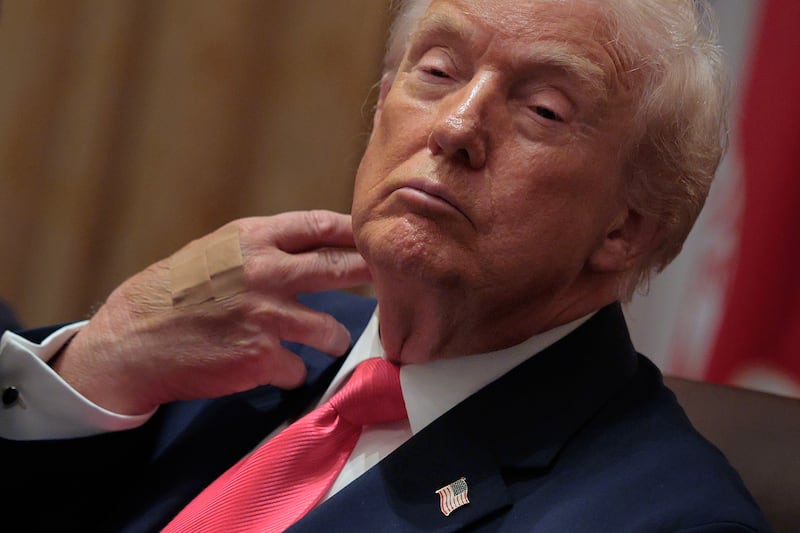
“I’m not a doctor, but I do think it’s curious that [Trump’s] drowsiness and visible bruising on his hands are consistent with known symptoms and side effects of Alzheimer’s medications like Leqembi,” Kamlager-Dove told the Daily Beast, which has been leading the charge on covering Trump’s health.
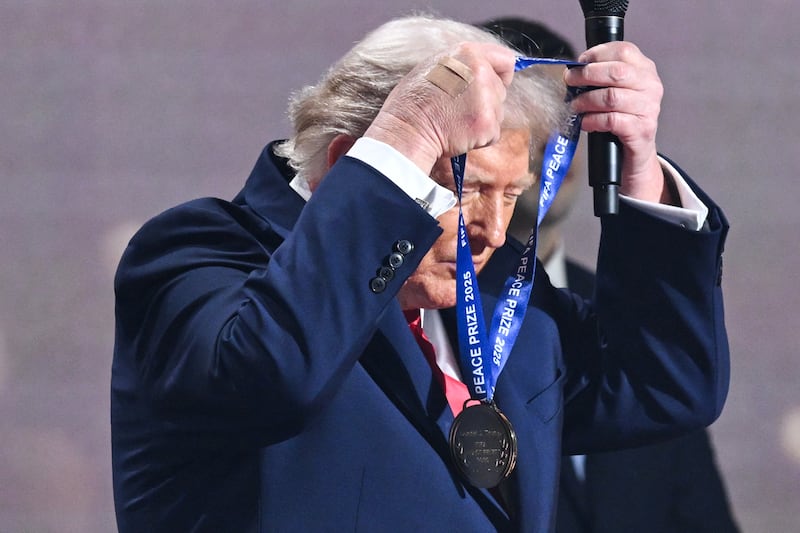
“His recent incoherent remarks at a rally in the Poconos and a Truth Social rant about his three cognitive tests have only intensified scrutiny of his memory and mental fitness,” she added.
The White House dismissed Kamlager-Dove’s theory.
“It seems as if the Congresswoman has not been taking her medication because she is hallucinating, distorting reality in a clearly troublesome state that requires urgent medical care,” White House spokesperson Steven Cheung told the Daily Beast.
Trump has long attempted to shut down questions about his mental fitness by bragging about how he aced cognitive function tests, which he’s wrongly called IQ tests.
However, there is reason to suspect Trump is at risk for Alzheimer’s. The Alzheimer’s Association notes that “those who have a parent or sibling living with Alzheimer’s are more likely to develop the disease than those who do not have a first-degree relative with Alzheimer’s.” Trump’s father, Fred Trump, suffered from the disease.
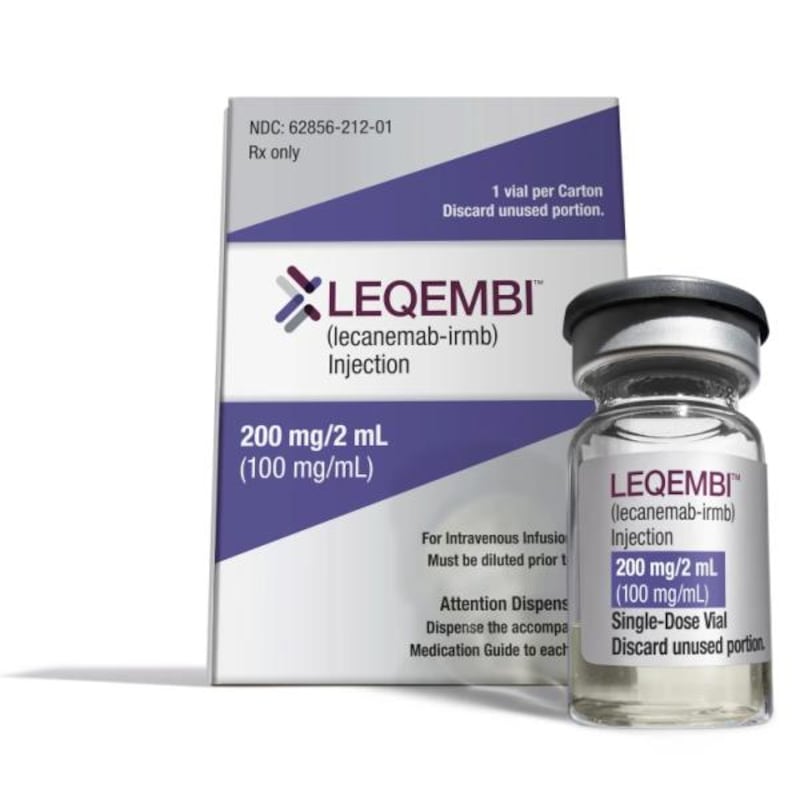
Leqembi, manufactured by Japanese pharmaceutical company Eisai, treats mild cognitive impairment, but it is not an Alzheimer’s cure. Drugs.com writes that Leqembi can delay the onset of severe cognitive decline by five months. The drug’s website suggests an 18-month course of Leqempi before assessing whether they should continue treatment.
The drug is administered every two weeks through an IV. Leqembi’s website says patients may experience “redness, swelling, heat, pain, itching, rash, bruising, and blood collection under the skin at the injection site.” Trump’s right hand has consistently shown bruising since February.
Leqembi patients receive regular MRIs every few doses to check for ARIA (Amyloid-related imaging abnormalities), which can manifest as brain swelling and microhemorrhages. These conditions are asymptomatic and can be fatal if left unchecked.
On Oct. 10, Trump received an MRI at Walter Reed Medical Center, which is typically not needed for a regular physical examination. The White House didn’t explain the MRI until December, when they said it was a “preventative” scan of his heart and abdomen. Doctors have sincerely doubted that explanation.
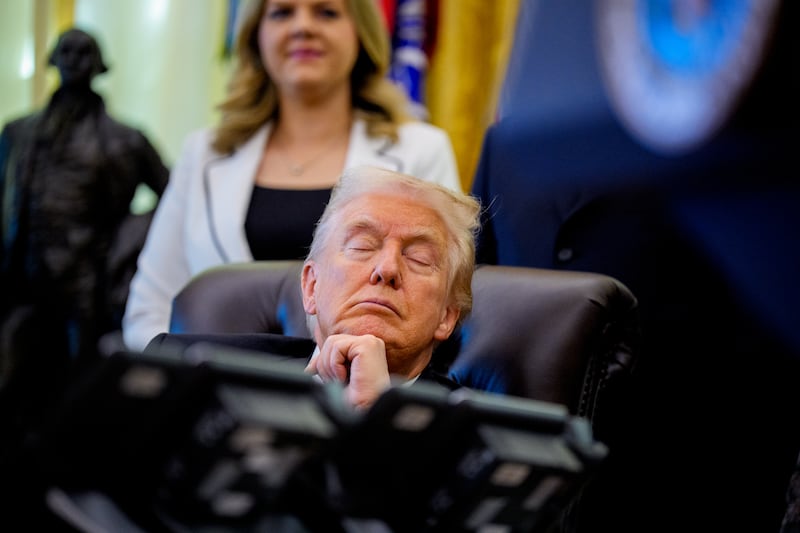
Leqembi patients may also experience fatigue, particularly after an injection. The president has noticeably struggled to stay awake during public appearances and meetings for weeks. The Alzheimer’s Association says Alzheimer’s patients may experience difficulty sleeping and take daytime naps.
Those close to Trump have tried to praise his fitness by boasting about how he rarely sleeps.
The post Congresswoman Goes There With Wild Theory on Trump’s Health appeared first on The Daily Beast.