When Park Chan-wook stepped into the international film spotlight in 2003 with the neo-noir thriller Old Boy, the director immediately drew attention for his stylized, no-holds-barred approach to depicting the futility of vengeance. For more than 20 years, the filmmaker has explored social contexts for some of humanity’s most destructive behavior in works like Lady Vengeance, The Handmaiden, and Decision to Leave by taking his stories in unexpectedly funny and poignant directions.
See, for example, the opening scene of Old Boy, which begins with scruffy-haired protagonist Oh Dae-su (Choi Min-sik) holding a man by the tie from the rooftop of a Seoul building. “I said I want to tell you my story,” Dae-su tells the man, who is clutching a small dog. His tale forms the meat of the movie, and Park still recalls that introductory sequence as a highlight of his work.
“It’s an enthralling opening sequence,” he says. “It immediately makes the audience very curious about the film. And more than that, it really sets up the unique nature of the narrative.”
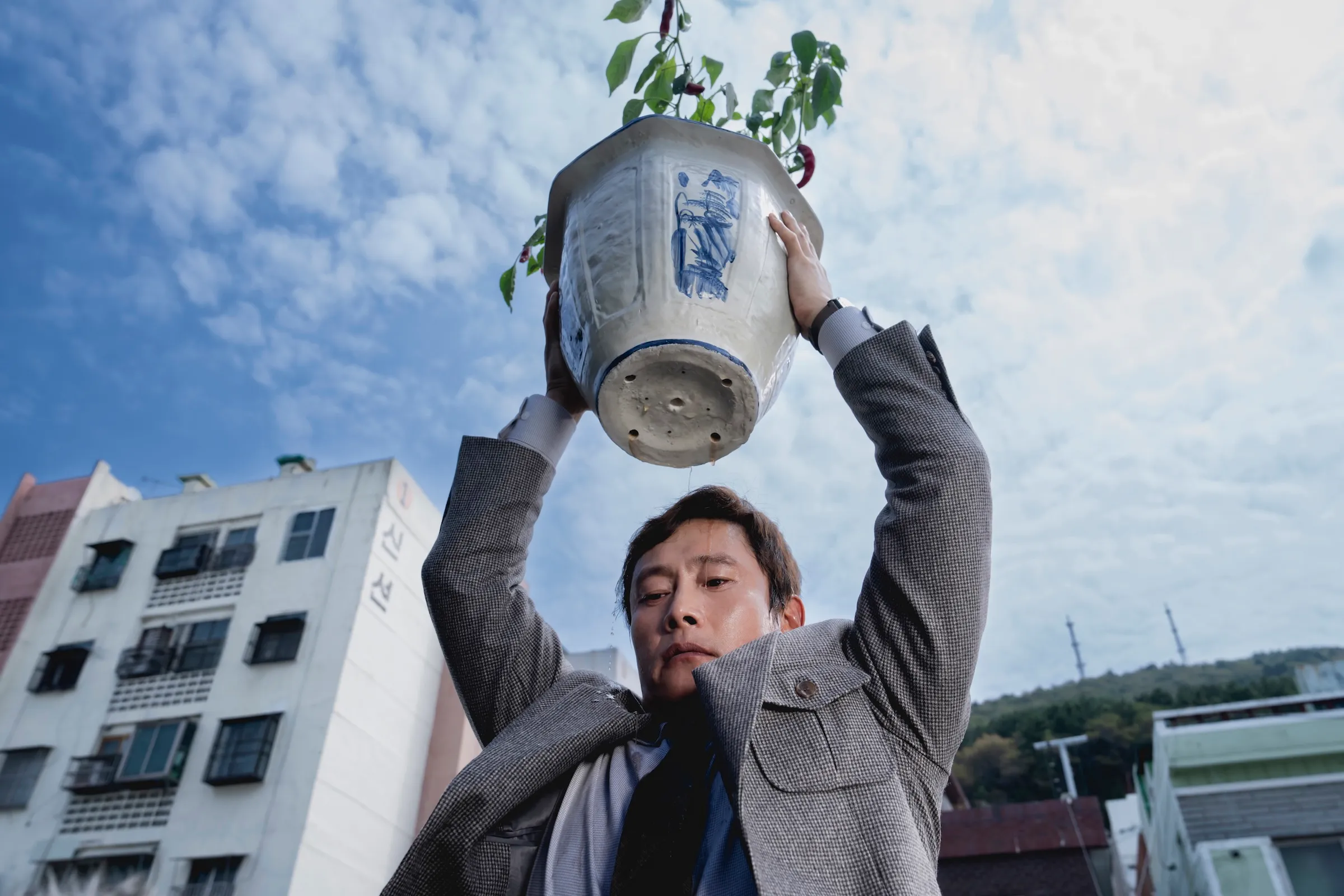
Park’s latest film, No Other Choice, which opens on Dec. 25, begins on a much different, but comparatively stilted tone. Yoo Man-su (Lee Byung-hun) happily grills eels for his family on a lovely summer day. The celebratory meal is a gift from Man-su’s employer, Solar Paper, where he has climbed his way to manager after 25 years of loyal service. The work has allowed Man-su to buy back his childhood home, and to provide other middle class comforts to wife Mi-ri (Son Ye-jin), teen son Si-one (Kim Woo-seung), and daughter Ri-one (Choi So-yul). Before diving into their summer barbecue, Man-su calls them all over for a group hug.
The loving moment is short-lived. While Man-su might not bear any immediate resemblance to Old Boy’s Dae-su, his suffering is also going to lead him to murder. The gifted eels were not so much celebratory as conciliatory—Solar Paper has been sold to an American company, and Man-su is promptly laid off, putting his family’s middle class lifestyle in danger. After more than a year of unemployment, following an off-hand comment from his loving wife, Man-su decides to start taking out his competition in the brutal labor market… permanently. What follows is a darkly humorous, uncomfortably relatable tale of modern worker desperation.
“Violence has always had an important role in terms of the history of mankind as a whole and in the lives of individuals as well,” Park says. “And you need to face violence in order to understand how mankind works. You can’t turn away.”
No Other Choice is based on Donald E. Westlake’s The Ax, a 1997 American novel that Park has been trying to adapt for most of his career. “It already contained the type of humor that I have always been a fan of, and I also felt like I could expand on that humor—go a bit bigger and also deeper.” When Park initially inquired about the rights in mid-2000s, he discovered it had been adapted into a 2005 French-language film, The Axe, by director Costa-Gavras. “I was honestly devastated at first, knowing that a master that I respect so much had already made a film of this book,” says Park. But, after watching The Axe, he realized his vision was different.
From around 2009, Park continued to try to make the film. “In between my films, I would always go back and retouch and revise the script. I always tried to get this movie funded.” Park put a lot of time into developing his vision for an American adaptation, scouting possible locations in the United States and Canada, and storyboarding the script. In the meantime, he continued building on his celebrated filmography, including with 2013 English-language debut Stoker, 2016 Fingersmith adaptation The Handmaiden, and 2022’s Decision to Leave. While Old Boy and the rest of Park’s “Vengeance trilogy” may have stood out for their precise, purposeful depictions of violence, the auteur’s meticulous eye and execution extends to all aspects of his filmic world, perhaps stemming from his time as a philosophy student in college.
“Rather than just observing something from the outside, I’ve been trained with this nature to relentlessly dig into the nature of what’s inside things,” he says. “So when I look at an issue, I don’t just briefly think about it or briefly look at it, I really go down to the roots of it all. And this attitude of really going down to the roots of observing something, I want to express this we’re using the word radical—and this radical is not radical in the sense of the political sense of the word and I’m not talking about the extremity in my filmography as well, like violence—it really is just that pure sense of the word radical.”
Park didn’t find commercial or critical success until his third film: Joint Security Area, a 2000 mystery set in the Korean Demilitarized Zone. However, he says the turning point in his career actually came right before that, with the making of a short film set in the aftermath of the Sampoong Department Store collapse called Judgment. “It was really immediately before I got to make JSA and I got some financial support from a video rental franchise company,” he recounts. “And, because I didn’t study at a film school, this was actually my first time making a short film, despite the fact that I’d already made two features.”
Because Park didn’t feel the pressure of box office tallies, he felt more liberated in the production. “So preparing for this was so much fun, and I put a lot of effort into it,” he says. To find the cast, he asked some of Korea’s most famous stage actors to be in his film. “For people who worked on stage plays, they’re very used to sitting with the writer and the director and having table reads for a long time. Going through that process, I was also able to experience more of character analysis and, in answering their questions, I could also organize my thoughts about the whole film as well. So this collaboration was a very important—and very fun process.”
The experience continues to influence his style today. “From JSA on, I’ve had a lot of conversations with the actors in pre-production, and we’ve also continued to have endless discussions on set as well. And I think that’s what fundamentally changed the nature of my films.” In the process, Park has collaborated with some of the world’s most celebrated actors, including Song Kang-ho, Nicole Kidman, Kim Tae-ri, Michael Shannon, Florence Pugh, Park Hae-il, Robert Downey Jr., Lee Byung-hun, and Son Ye-jin.
Finally, following the success of Decision to Leave, Park secured funding for his adaptation of The Ax—but for a Korean version of the film. He asked Lee Byung-hun, whom he first worked with all those years ago on JSA, to star. When asked how No Other Choice would be different if he had made it earlier in his career, Park is of two minds.
“It’s hard to consider this film in relation to my other works, but I guess I would have become a more mature and more experienced filmmaker at the time that I made No Other Choice. With the work of a more experienced filmmaker, you’re able to use different tools from your filmmaking toolbox, and you’ll be able to use them well, like a trained handyman,” he says. “But, at the same time, I do consider maybe if I made this film back when I was younger, it might have come off as a more creative and bold film.”
No Other Choice, which has already been released in Korea and has been making the film festival circuit since its Venice premiere in August, has been acclaimed by critics and audiences for the timeliness of its themes in the age of AI, but Park says that it has been timely since he first started trying to get the film made. It’s relatable for anyone living and working under modern capitalism.
No Other Choice has been shortlisted in the Best International Feature Film category at the Oscars and if it wins, it will be Park’s first Academy Award. Though most film critics would agree that the recognition is far past due, the Korean director speaks about reaching for a different metric.
“I’ve always been trying to follow the footsteps of the great masters of cinema, most of whom have passed away today,” he says. “I’ve tried very hard to reach their level. And I think in certain scenes or certain films, I might have reached a similar level, but there’s still a very long way to go. So, when I think about how many more films I can make for the rest of my life, I feel very rushed.”
The post Park Chan-wook on the Long Journey to No Other Choice appeared first on TIME.