We’ve been aware that interstellar comet 3I/ATLAS is up to some weird stuff again. Well, the crowd that usually thinks every one of its oddball behaviors means it’s of alien origin is back at it again, too. This time, they’ve spun up their conspiracy theory engines as 3I/ATLAS is experiencing “non-gravitational acceleration.”
This is a set of words that can instantly conjure fantastical mental images of, let’s say, 3I/ATLAS actually being an alien attack vessel disguising itself as an ancient comet. And now that it’s made it far enough into our solar system, it can drop the act and begin its attack on the Earth.
The truth, as is almost always the case, is less imaginative but still fascinating, assuming your definition of interesting isn’t exclusively based on blockbuster alien invasion movies.
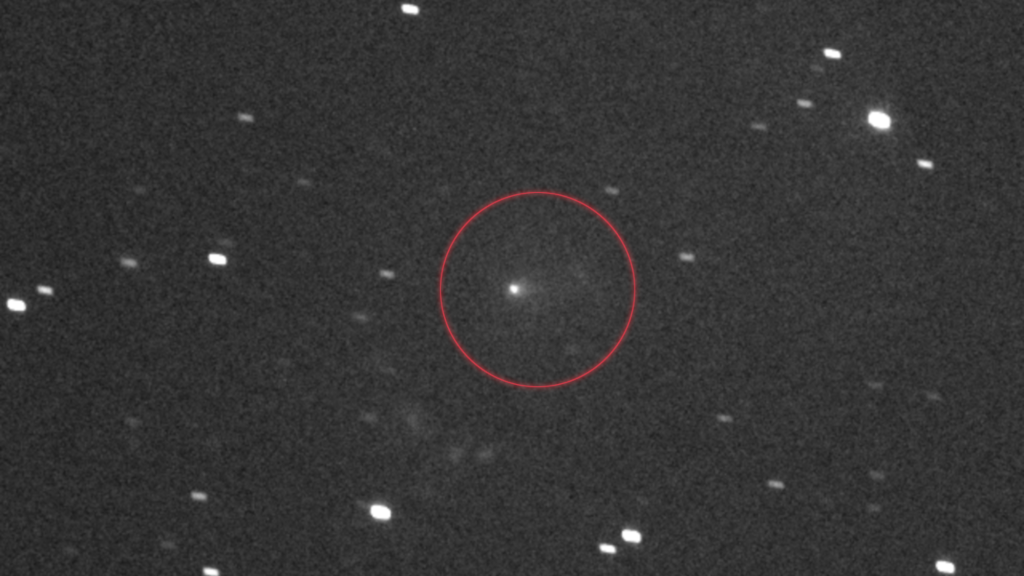
The Strange Motion of Comet 3I/ATLAS, Explained by Science
According to research published in Research Notes Of The American Astronomical Society, in reality, non-gravitational acceleration is a pretty basic comet behavior. Comets are lumpy, fragile mixes of rock and frozen gases.
So, as they approach the sun, ice heats up and sublimates, turning from a solid into a gas. That’s where a comet’s iconic tail comes from. The process isn’t uniform. It is actually uneven and unpredictable.
Jets of material blast off the surface at odd angles, forming the tail and the comma. All the while, gently pushing the comet around, creating an unbalanced, wobbly effect that could affect its ultimate trajectory.
It’s more of a lumpy, misshapen potato than it is a precisely engineered sphere that’s slicing through space. These gas jets fire off at different angles and intensities over time. That cumulative effect I mentioned earlier, the one that alters the comet’s trajectory over time, that’s the “nongravitational” part of the motion.
It’s motion that isn’t caused by the gravitational pull of a planet or the sun, but by the comet’s burps and farts, to put it as immaturely as I can.
Researchers around the world are pointing their space instruments at 3I/ATLAS to measure its movement. They have found that it’s accelerated by about ½ a micron per second squared. Astronomically speaking, that is extremely tiny, almost insignificant, and most certainly not what you’d expect from an object that was a secret alien in disguise.
Interestingly, by modeling this acceleration, scientists estimate that 3I/ATLAS’s mass before it reached the sun was around 44 million metric tons. That is about the size of seven Great Pyramids of Giza, with a nucleus around 375 meters wide, making it smaller than we had previously assumed.
Still massive, just not as massive as we once thought.
The post Why Comet 3I/ATLAS Is Moving So Strangely, According to Scientists appeared first on VICE.